Finalise my selection 0

You have not selected any product

retread background

TYRE RETREADING SERVICE

Transform your truck and bus tyres with our tyre retreading solutions, giving them a second life and saving you costs at the same time.

TYRE RETREADING: A COST-SAVING AND SUSTAINABLE CHOICE

Discover the perfect blend of Michelin quality, cost savings, and environmental benefits. Extend the life of your tyres, improve fuel efficiency, and maximise your total cost of ownership while reducing waste. Boost your bottom line with Michelin retreaded tyres today! 

transport forward 01

WHY SHOULD YOU RETREAD TYRES WITH US?

Our innovative retreading process ensures you get retreads you can trust, helping you save money and keep your trucks on the road. By leveraging Michelin’s cutting-edge technology, proven tread designs, and stringent manufacturing standards, the MICHELIN Retread Technologies process delivers reliable retreads tailored to your needs, maximizing the value of your tyres.

BENEFITS OF RETREADING

cost effectiveness

1. COST-EFFECTIVENESS

Retreaded tyres offer a significant cost-saving alternative to new tyres without compromising on quality and performance. They are 50% cheaper than an equivalent new tyre which is ideal for fleet operators looking to reduce overall operating costs.

green bib

2. ENVIRONMENTAL AND SAFETY BENEFITS

By reusing tyre casings, retreading reduces waste and conserves natural resources, making it an eco-friendly choice. Retreaded tyres undergo rigorous testing to ensure they meet safety standards and deliver reliable performance.

durability

3. DURABILITY AND CUSTOMISATION

Modern retreaded tyres are built to last, providing durability and longevity comparable to new tyres. Retreaded tyres can also be customised to suit various driving conditions and vehicle types, providing flexibility and tailored solutions.
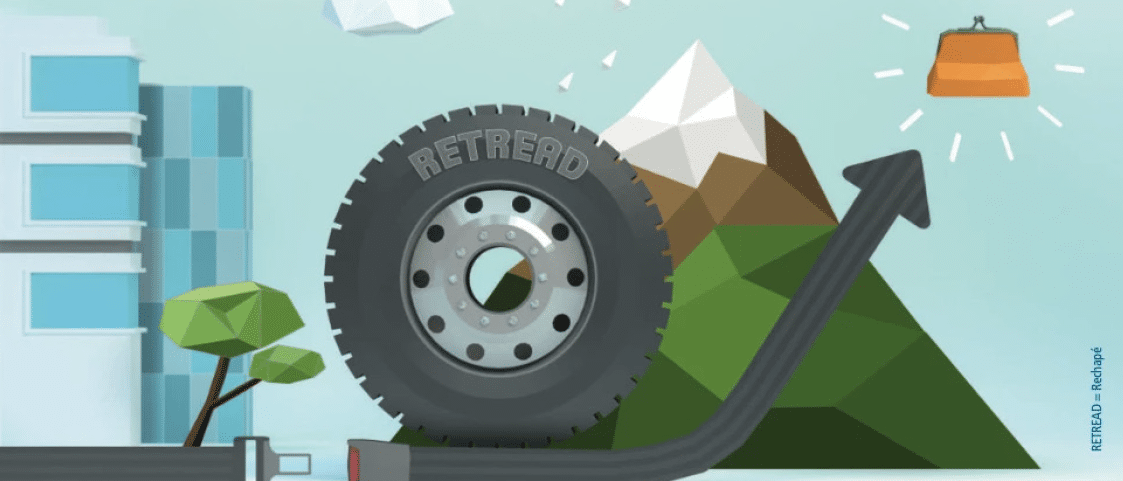
retread image

READ OUR WHITE PAPER ABOUT TYRE RETREADING

Retreads are now safe and reliable, contrary to old myths. The truck industry saves billions of dollars each year by retreading, with owners investing in high-quality tyres and retread them instead of buying new tyres. Learn more about the myths surrounding retreads in the white paper below. Share these myths and truths with your drivers to assure them of the safety and performance of retreads.

How MICHELIN retreading works

Retreading reuses the most expensive part of a truck tyre. The casing represents the majority of the tyre's manufacturing cost and, if it comes out of service undamaged, it has years of service left in it.

The process runs in four stages:

  1. Casing inspection. Every casing is assessed for structural integrity before it enters the process. Casings that fail inspection are rejected, not repaired around.
  2. Buffing. The remaining tread is removed back to a specified depth, leaving the casing and belt package intact.
  3. New tread application. A MICHELIN tread pattern matched to the intended axle position and application is applied.
  4. Curing and final inspection. The finished tyre is cured and inspected before release.


Casing quality is what determines whether retreading works as an economic strategy. A fleet running correct pressures and pulling tyres before casing damage occurs gets far more retreadable casings back than one running to failure. This is why retreading and pressure management are usually specified together rather than separately.

Retreading and your maintenance obligations

Tyre condition forms part of a heavy vehicle operator's maintenance obligations under Chain of Responsibility duties in the Heavy Vehicle National Law. Retreaded tyres are subject to the same roadworthiness requirements as new tyres, and retreading in Australia is carried out to Australian Standard requirements for truck and bus retreading processes. Retread choice does not change your obligation to inspect and maintain.

FAQ

How many times can a truck casing be retreaded?

It depends entirely on casing condition rather than a fixed number. A well-maintained casing that has not run underinflated or sustained impact damage can be retreaded more than once. Casing inspection at each cycle is what decides it.

Are retreaded tyres as safe as new tyres?

Retreaded tyres are manufactured to defined standards and subject to the same roadworthiness requirements as new tyres. The old perception of retreads comes from an era before modern casing inspection and controlled curing.

What causes a casing to be rejected?

The most common reasons are run-flat or severe underinflation damage, sidewall impact damage, and penetration into the belt package. Most rejections trace back to pressure management rather than mileage.

Which axle positions suit retreads?

Drive and trailer positions are the most common applications for Australian fleets. Steer position retreading policy varies by operator and should be discussed with your Michelin representative.

Do you want to talk to a Michelin's Retreading Expert? Contact us!

common.error.invalidField:This field is invalid
0/4
1 to 20 21 to 199 Beyond 200
common.error.invalidField:This field is invalid
I agree to the use of my personal data to receive newsletters and commercial advertisements from Michelin by e-mail.*
common.error.invalidField:This field is invalid

Fields with an (*) are mandatory

You are using and outdated Web Browser..

You are using a browser that is not supported by this website. This means that some functionality may not work as intended. This may result in strange behaviors when browsing round.

Use or upgrade/install one of the following browsers to take full advantage of this website

Firefox 78+
Edge 18+
Chrome 72+
Safari 12+
Opera 71+